
Corellian Spike Sabacc
Complete Rules and Ranked Sabacc Hands
Casino Suitable
Card Game for 2 to 8 players
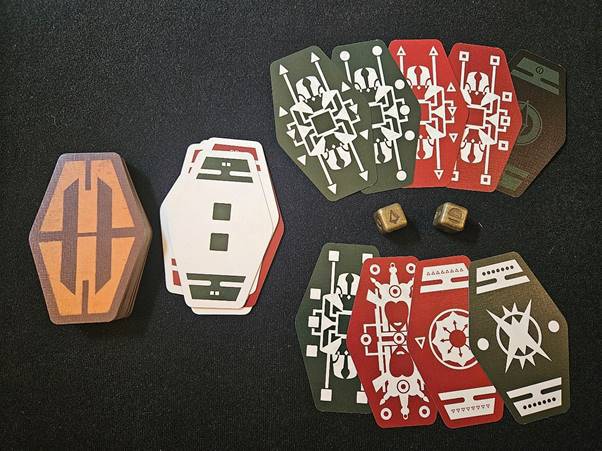
The deck consists of 62 cards.
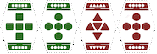
There are 3 suits: Triangles, Squares, and Circles.
Each suit has 20 cards, 10 green cards with positive values from +1 to +10:

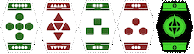
and 10 red cards with negative values from -1 to -10:

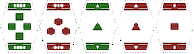
There are two cards with value 0 called Sylop:
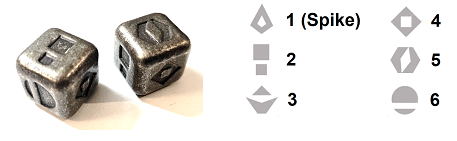
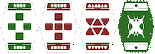
The Spike Dice are 2 six-sided dice with symbols representing numbers. The “Spike” symbol represents 1 and has a special meaning in Corellian Spike Sabacc.
Game Setup
Choose a dealer. If the dealer is also a player, the dealer rotates to the left each game.
Players agree on ante costs, minimum and maximum bets and raises, and fees. (e.g. ante hand and Sabacc Pot: 2 credits each, no min-max bets, no fees)
For each game, all players pay an ante into the Hand Pot and an ante into the Sabacc Pot. The Hand Pot is won by the winning hand. The Sabacc Pot is won by the winning hand only if it is a Sabacc (total sum of 0) and grows each game if not won.
The dealer shuffles the deck.
The dealer deals 2 cards face down to each player individually starting with the player to their left. The players make sure no other player can see the faces of their cards.
The dealer puts the remainder of the deck face down on the table as the Draw Pile.
The dealer takes the top card of the Draw Pile and places it face up next to it to start the Discard Pile.
Gameplay
Each game consists of 3 rounds, with each round having these 3 phases:
Cards, Spike Dice, Betting.
The player to the left of the dealer is the starting player. The starting player starts each phase. The starting player rotates to the left each completed game.
(Some actions may require a fee, if agreed on before starting to play. For example, a fee for drawing or swapping. Fees are paid into the Hand Pot. Default is no fees.)
Cards
The player can choose one of the following actions:
- Stand: Player makes no changes to their hand and passes their turn.
- Draw (Gain): Player takes the top card from the Draw Pile and adds it to their hand
- Discard and Draw: Player places a card from their hand face up on the Discard Pile, then takes the top card from the Draw Pile and adds it to their hand.
- Swap: Player takes the top card from the Discard Pile and places another card from their hand face up on the Discard Pile.
Once the player has completed their action, the player to their left takes their turn until all players have had their turn in the Cards phase. A Player can only perform one action per card phase.
Spike Dice
The dealer rolls the Spike Dice. If the two dice do not show the same symbol, nothing happens. Proceed to the Betting phase.
If the two dice show the same symbol, but the two symbols are not the Spike, all players, in order, discard one card of their choice face up on the Discard Pile and draw a new card from the Draw Pile. This is like a forced single card Discard and Draw. Each player discards and draws before it is the next player’s turn.
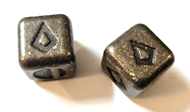
If both dice show the Spike symbol, all players, in order, must discard all their cards face up onto the Discard Pile (wipeout) and draw the same number of cards they discarded from the Draw Pile. Each player discards all their cards and draws all their new cards before it is the next player’s turn.
Betting
The player can choose to
- Check: Player makes no bet.
- Bet: Player states an amount and pays the amount into the Hand Pot.
- Call: Player matches the amount of the current highest bet and pays it into the Hand Pot to stay in the game.
- Raise: Player calls the amount of the current highest bet, raises by an additional amount and pays it into the Hand Pot.
- Fold: Player places all their cards face down under the Discard Pile – they “junk” their cards - and exits the game. A player is not allowed to fold unless there are previous bets to call. If there are no previous bets to call, a player must check if they do not want to bet more.
A player must call or raise a previous bet to stay in the game. Otherwise, they must fold.
To prevent squeeze-outs, going all-in counts as calling. A player may not win more from any opponent than they have risked (“table stakes”). When one or more players are all-in for less than the current bet, create a main pot consisting of the smallest all-in amount matched by all active players, and one or more side pots for any additional amounts bet by other players. Only players who contributed to a given pot are eligible to win it. No bets carry over between hands. Any bet amounts not matched by at least one other player are returned to the bettor at the end of the hand. The Sabacc Pot does carry over if not won. An all-in player can win the full Sabacc Pot.
This phase continues in order until all players have either checked, called, or folded.
If this was the third round, proceed to Reveal; otherwise start the next round.
Reshuffle
If at any time, the Draw Pile runs out of cards, the dealer sets aside the top card of the Discard Pile face up to start a new Discard Pile. The dealer then shuffles the rest, including any “junked” cards, and places it face down as the new Draw Pile.
Reveal
All players who have not folded calculate the total value of their hands. (Adding up the values of all their cards)
The player with a sum of zero or closest to zero wins (see Determining the winner).
The winning player collects the Hand Pot.
If a player wins with a Sabacc (Sum of 0) that player also collects the Sabacc Pot.
If all but one player fold in any round before the reveal, the game ends immediately without revealing any hands and the last player left wins the Hand Pot only, no matter the hand they had at that moment.
But players are not allowed to fold unless there are previous bets to call in a Betting phase. If there are no previous bets to call in a Betting phase, players
must check if they do not want to bet more.
Determining the winner
Many times, the game will end with more than one player being “closest to zero” or at exactly zero (Sabacc). These are the rules to determine who wins the game.
Sabacc (Hand is 0)
If more than one player has a Sabacc (Total value of 0), the player with a ranked hand wins. Ranked hands are special named Sabacc hands with certain patterns.
If more than one player has a ranked hand, the highest-ranking hand wins (see the ranking list and tiebreaking under Ranked Sabacc Hands).
If more than one player has a Sabacc, but none have a ranked hand, the general tiebreakers apply in the order listed (see Tiebreakers).
Nulrhek (Hand is not 0)
A Nulrhek is a hand not at zero. If more than one player is equally “closest to zero” the player with a positive sum wins (e.g. +2 beats -2). If this is also a tie the general tiebreakers apply in the order listed (see Tiebreakers).
Tiebreakers
- Most cards wins.
The hand consisting of more cards wins
- Highest sum of the absolute values wins.
(An absolute value is the positive of a value, so for ‘-8’ the absolute value is ‘8’,
for ‘7’ it stays ‘7’ (already positive)).
The easiest way to think about it is: Just ignore the colour of the cards for this and add all cards together as if they were all positive!
Example: [+7,-6,-6] (7+6+6=19) beats [-10,+3,+2] (10+3+2=15).
- Card with highest absolute value wins, comparing highest to lowest.
For this also, just ignore the colours of the cards and compare them highest to lowest. The player that first has a higher card, wins.
Example: [-9,+7,+5,-3] (9, 7, 5, 3) beats [+8,-7,-5,+4] (8, 7, 5, 4).
- Card with highest positive value wins, comparing highest to lowest.
Same as above but this time just compare the green cards.
Example: [+8,-7,-6,+5] (8, 5) beats [-8,+7,+6,-5] (7, 6).
- Suited hands:
Suited hands (all cards having the same suit) win over mixed-suit hands. Sylop has no suit and does not break the suited status of a hand. So, for example, a hand with only Circles and a Sylop is still suited.
- Single Card Draw:
If still tied after all other tiebreakers, the tied players draw one card each from the Draw Pile in order, card closest to zero wins, positive values beating negative values. Repeat if still tied until resolved.
Ranked Sabacc Hands
The higher ranked hand wins. If tied, higher keys win for all ranked hands.
Keys are the absolute values of the pattern of a ranked hand. Most patterns are already defined by absolute values, so this is quite intuitive. E.g. for the pair [+8,-7,-7,+6] the key is 7. For a Khyron [-10,+9,+8,-7] it’s the highest, so 10. For Rhylets, it’s the triplet’s key (the pair is dictated by the triplet for a zero hand). Only (Sylop) Rule of Two has 2 keys (pairs). Compare the higher key first, then the lower. Other cards or Sylops don’t count as key.
If still tied, the general tiebreakers apply in the order listed (see Tiebreakers).
The following table contains all the ranked hands in order of rank, their description and an example with its keys. Reminder: All ranked hands are 0-sum (Sabacc)!
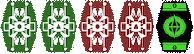
1. Full Sabacc
A “Fleet” with 10s:
[+10,+10,-10,-10,0]
[+10,+10,-10,-10,0], key: 10
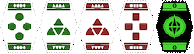
2. Fleet
A four of a kind (by absolute value) and a Sylop.
+4,+4,-4,-4,0], key 4
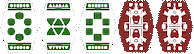
3. Rhylet
A positive three of a kind and negative pair, or vice versa.
[+6,+6,+6,-9,-9], key 6
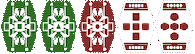
4. Wild Rhylet
A three of a kind and a pair (by absolute values).
[+10,+10,-10,-5,-5], key 10
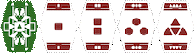
5. Gee Whiz
Exactly [+10,-1,-2,-3,-4]
or [-10,+1,+2,+3,+4]
[+10,-1,-2,-3,-4], key 10
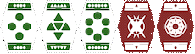
6. Full Straight
A sequential run of 5 cards (by absolute values) without a Sylop.
[+4,+5,+6,-7,-8], key 8
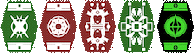
7. Sylop Straight Khyron
A sequential run of four cards (by absolute values) plus a Sylop.
[+7,-8,-9,+10,0], key 10
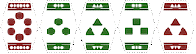
8. Five Card Squad
A four of a kind (by absolute value) with a fifth card, no Sylop.
[-6,+3,+3,+3,-3], key 3
9. Squadron
A four of a kind (by absolute value) and no other card.
[+5,+5,-5,-5], key 5
10. Sylop Rule of Two
Two pairs (by absolute values) plus a Sylop.
[+5,-5,+3,-3,0], keys 5,3
11. Banthas Wild
A three of a kind (by absolute value) and one or two other cards.
[+4,-3,+1,-1,-1], key 1

12. Pure Sabacc
Exactly both Sylops and no other cards.
[0,0], no key
13. Straight Khyron
A sequential run of four cards (by absolute values). No Sylop, no other card.
[+4,-5,-6,+7], key 7
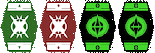
14. Idiot's Rule
A pair (by absolute value) plus both Sylops. No other card.
[+7,-7,0,0], key 7
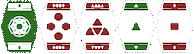
15. Rule of Two
Two pairs (by absolute values), no Sylop. May contain a fifth card.
[+8,-4,-4,+1,-1], keys 4,1
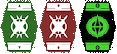
16. Yee-Haa
A pair (by absolute value) plus one Sylop. No other cards.
[+7,-7,0], key 7
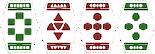
17. Pair
One pair (by absolute value) and 0 to 3 other cards.
Can contain Sylops, but 2 Sylops do not constitute a pair.
[+6,-5,-5,+4], key 5
 Druckversion