
Corellian Spike Sabacc

PDF-Dokument [1.1 MB]
Here you can find real-world, casino worthy Corellian Spike Sabacc Rules that are truly consistent in their ranked hands and one universal, complete, and consistent tiebreaker chain with no exceptions.
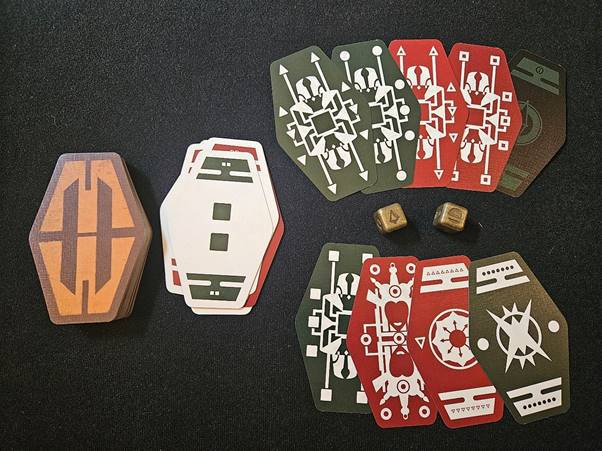
Corellian Spike Sabacc is a card game for 2 to 8 players using a 62-card deck divided into three suits, with the goal of assembling a hand of 2 to 5 cards that sums to zero or closest to zero. The game involves phases of drawing cards, rolling Spike Dice, and betting, with specific actions available to players during each phase. Winning is determined by the hand's value, with various ranked hands and tiebreakers outlined for resolving ties. See Rules.
The ranked hands are strictly ordered by probability and real game frequency. No "rule of cool" exceptions that put a 1/200 hand above 1/20000 hands. Also they have been made more inclusive. The Galaxy'y Edge definitions are unnecessarily restrictive for some of the hands, excluding hand formations that clearly deserve to be recognized .(like all Full House patterns, Full Straights with 5 cards, 4 of a kind with 5 cards etc.) The original names and their restrictive definitions have been kept in for their familiarity but they are now treated as special cases of the wider definition and are placed with them in the hierarchy accordingly.
The rules are kept simple and streamlined, easy to learn, easy to teach, easy to adjudicate, and watertight at a casino table. No per-rank “if/then/else/unless/otherwise” branches or complicated card phase additions. See Reference Sheet.
The spike dice have been toned down and are now less disruptive, often giving players opportunities to improve their hands rather than radically changing the game state.
Also of course betting comes after all randomness in a round, meaning after the spike dice, so you bet on the hand you are actually going to reveal and not a 1-in-6 "oops, I have another hand now" lottery between bet and showdown.
In Solo: A Star Wars Story Han and Lando also do not roll any dice after they went all in, including betting a heavily modified C.E.C. YT-1300f light freighter...
So if you want to have a truly consistent casino ready gambling game rooted in the rich Star Wars universe, this is it.
You can either download the complete rules with examples and a printable reference sheet below, or find them in the rules section.
There is also a document explaining the reasoning behind these rules with probapility calculations and results that went into developing these rules. if you are interested in this kind of thing. Or just keep reading. It is also on this page.
PDF-Dokument [1.1 MB]
PDF-Dokument [3.8 MB]
Calculations, analysis and reasoning
Below is the reasoning behind the choices, with supporting stats and how they map into the rules.
1) Philosophy: rarity → rank, and “higher key” should win
Ranking by rarity. In poker, the rarer hand ranks higher; Sabacc should follow the same logic. My simulations and combinatorics show that when we look across families of ranked hands (e.g., all Rhylet variants together, all Straights together, see ranked hands below), rarer families are placed higher than more common ones. This keeps incentives and expectations aligned: hard things are rewarded accordingly.
Higher key beats lower key inside the same rank. Some argue “lower integer” should win because “the goal is to be closer to zero anyway.” But that overlooks risk. (I call the
“integer” the key, because “integer” can be ambiguous)
Example: drawing from [+2,+2,-2] vs [+9,+9,-9] to try to get a Squadron: It’s not that the probability to get a Squadron with 2s is higher than with 9s. These are the same. It’s
that misses with the high-key chase push you much farther from zero on average, and misses are much more common. If you do land the higher key, you have succeeded despite
greater expected downside along the way. Ranking the higher key higher correctly rewards that risk.
I ran a simulation with 2 players and sent them Squadron hunting for one million games. I dealt one of them a fixed [+2,+2] and the other [+6,+6] at the start of each game for the whole simulation run and gave them their target. The droids are intelligent enough to change strategy and just aim for zero if the Squadron is mathematically no longer achievable. I used Galaxy’s Edge rules and ranked hands for that simulation to avoid confusion. The results speak for themselves:
Outcome
-------
Player 1 (('hunter', 'Squadron')): Win 56.66 % (566593), Start [2, 2] (sum 4)
Player 2 (('hunter', 'Squadron')): Win 43.34 % (433407), Start [6, 6] (sum 12)
So why did player one win more often? Let’s have a look at the details:
Player Statistics
-----------------
Player 1:
Win %: 56.66 (566593)
Start: [2, 2] (4)
Mode: ('hunter', 'Squadron')
Avg distance from zero after game: 6.38
Exact zero %: 15.11 (151085)
Total named hands %: 8.90 (88954)
Named totals: Yee-Haa: 5101, Squadron: 5073, Gee Whiz!: 1, Straight Khyron: 1908, Banthas Wild: 1014, Rule of Two: 4129, Pair: 71728
Player 2:
Win %: 43.34 (433407)
Start: [6, 6] (12)
Mode: ('hunter', 'Squadron')
Avg distance from zero after game: 7.85
Exact zero %: 9.78 (97770)
Total named hands %: 3.43 (34329)
Named totals: Fleet: 1, Yee-Haa: 6155, Squadron: 5258, Gee Whiz!: 2, Straight Khyron: 1918, Banthas Wild: 67, Rule of Two: 3857, Pair: 1707
It is not the frequency they hit a Squadron; that small difference is negligible. Player 2 even hit it slightly more often:
Player 1: Squadron: 5073
Player 2: Squadron: 5258
The interesting numbers are these:
Player 1: Avg distance from zero after game: 6.38, Exact zero %: 15.11 (151085)
Player 2: Avg distance from zero after game: 7.85, Exact zero %: 9.78 (97770)
So for player 2 to even have a chance against player 1 in the long run they would have to ditch the high-value cards immediately, because sticking with high values is more risky. (The hunter mode
made both stick to their cards as long as Squadron was still theoretically (mathematically) achievable)
2) Universal, short, and consistent tiebreakers
It keeps one compact tiebreaker chain for all outcomes—Nulrhek and Sabacc, ranked and unranked. If multiple at zero, ranked-hand beats unranked, higher rank wins, then higher key, then general tiebreakers; for equal-distance Nulrhek, positive beats negative, then general tiebreakers.
- Most cards wins →
- Highest Σ|cards| (sum of absolute values; look at all numbers, ignore colors) →
- Highest |card| (compare highest to lowest; look at all numbers, ignore colors) →
- Highest positive card →
- Suited (last numeric resort; Sylop doesn’t break suited) →
- Single-card draw (only if still tied)
This mirrors the production notes of the film rules in Solo and avoids per-rank “if/then/else/unless/otherwise” branches. It’s easy to learn, fast to adjudicate, and watertight at a casino table.
Why highest Σ|cards|, and not only highest sum of all positives?
Using Σ|cards| matches the film’s “numbers first” spirit and avoids ignoring half the hand too early. If two hands have the same real-value sum, comparing positives only would produce the same
winner—but later we do return to all cards (highest |card|). Staying with Σ|cards| here keeps the chain consistent. Example: [-8, +7, +5, -4] vs [-9, +7, +5, −3] → equal Σ|cards| (24), then
highest |card|: 9 beats 8. Only if still tied do we check “highest positive,” and suits are truly the last resort. Without this the above hands would tie and force a single card draw immediately. But
they are clearly different hands, so they should not tie.
So Why Highest |card|?
See the above example: [-8, +7, +5, -4] vs [-9, +7, +5, −3]
If you go directly to highest postive cards after highest Σ|cards| (or highest sum of positive cards if you will, same difference), these hands tie. That should not be! They are clearly not the same hand by values. With highest |card| these hands are resolved correctly, preventing a tie and a single card draw. And we want to prevent a single card draw if possible! The highest |card| prevents these ties and also takes into account all cards and does not ignore half of the hand for tiebreaking too soon.
Why suits and why at the end? Suits are not the focus of any realistic strategy. You would never reject a card from the discard pile that gets you a Sabacc, just because it is not
the right suit. Only the straights and the (2-) pairs can be suited anyway. It is only introduced as a last tiebreaker to shave off some single card draws if possible.
3) Ranked hands: families, special cases, and clear placement
I keep all the familiar named hands (Rhylet, Yee-Haa, etc.) but recognize families where the original Galaxy’s Edge list feels incomplete or too constrained. Example: Wild Rhylet generalizes Full House patterns beyond matching signs; Full Straight fills an obvious sequence gap; Five Card Squad distinguishes rarer four-of-a-kind patterns at 5 cards. In the rules, all ranked hands are enumerated with examples, keys, and a single tie logic (“higher key wins; else general tiebreakers”).
Three key clarifications:
- Pure Sabacc (0,0) is not top rank. It’s elegant, but comparatively common in long runs, so it ranks below much rarer patterns—consistent with the rarity-first philosophy.
- “Special cases” stay special, not dominant. Full Sabacc is the Fleet-of-10s special case; “Rhylet” is the special version of the Rhylets with same sign triplet and pair; “Gee Whiz!” is the unique fold-over 5-card straight; “Idiots Rule” is the special version of Rule of Two with one of the pairs being the 2 Sylops. These remain in the hierarchy, with their family—but rarity still decides where they live.
- The Sylop variants are their own family. Sylop Straight Khyron and Sylop Rule of Two follow the example of Fleet vs Squadron, or Yee-Haa vs Pair with no additional cards that do not belong to the pattern. The others are either already 5 card hands or must contain cards not belonging to the defining pattern.
4) Spike Dice: less whiplash, more play
Classic rule: any doubles can trigger a wipeout. Table experience and sims suggest that frequent hard resets feel swingy and frustrating (if you play for real money at least ?). An alternative is to treat non-Spike doubles as a forced single discard+draw instead of a wipeout. That keeps the “Spike Sabacc flavor,” but creates more opportunities to improve hands and reduces resets. Only double Spikes trigger a wipeout. In practice, double Spikes appear about once in a dozen rounds—roughly once every four games—so this tweak smooths the rhythm without diluting identity (and adds another meaning to the Spike).
5) Betting belongs after Spike Dice
For real‑money play, your last information update should come before betting. If you’re going to bet a heavily modified C.E.C. YT-1300f light freighter, you should know which hand you’re betting on—so betting comes after Spike Dice. The turn structure in the rules is Cards → Spike Dice → Betting, for three rounds. That way, your wager reflects the hand you’ll actually reveal—no 1-in-6 “my hand just changed” lottery between bet and showdown. Pots use standard table-stakes logic with side pots to prevent squeeze-outs; folding is disallowed when checking is possible to prevent angle-shooting Sabacc Pot blocking.
6) Evidence: simulations and combinatorics
Here are a few datapoints from long runs (multi-million hand simulations, 4 players), plus a closed-form count across five sequential draws. These support the ranking-by-rarity stance and show, for example, why Pure Sabacc shouldn’t sit at the top, and Yee-Haa is also totally overrated.
Galaxy’s Edge rules, 8 million games per targeted ranked hand, 4 players:
|
Pure Sabacc |
141,278 |
|
Full Sabacc |
79 |
|
Fleet |
667 |
|
Yee-Haa |
773,297 |
|
Rhylet |
67 |
|
Squadron |
22,114 |
|
Gee Whiz |
988 |
|
Straight Khyron |
229,528 |
|
Banthas Wild |
50,424 |
|
Rule of Two |
704,204 |
|
Pair |
6,308,510 |
This (Casino) version, 8 million games per target hand, 4 players:
|
Ranked Sabacc Hand |
Hand Type |
Frequency |
|
|
Full Sabacc |
Sylop + 4 of a kind |
1,599 |
166 |
|
Fleet |
1,433 |
||
|
Rhylet |
triplet + pair (Full House) |
2,498 |
146 |
|
Wild Rhylet |
2,352 |
||
|
Gee Whiz |
5 card straights |
10,031 |
2,045 |
|
Full Straight |
7,986 |
||
|
Sylop Straight Khyron |
Sylop + 4 card straight |
16,965 |
16,965 |
|
Five Card Squad |
4 of a kind |
33,079 |
703 |
|
Squadron |
32,376 |
||
|
Sylop Rule of Two |
Sylop + 2 pairs |
47,018 |
47,018 |
|
Banthas Wild |
3 of a kind |
74,439 |
74,439 |
|
Pure Sabacc |
2 Sylops |
165,352 |
165,352 |
|
Straight Khyron |
4 card straight |
313,450 |
313,450 |
|
Idiots Rule |
2 pairs |
895,483 |
22,690 |
|
Rule of Two |
872,793 |
||
|
Yee-Haa |
Sylop + pair |
955,445 |
955,445 |
|
Pair |
pair |
6,348,423 |
6,348,423 |
- Very rare families: Full Sabacc and Fleet, Rhylet and Wild Rhylet, Gee Whiz and Full Straight, Sylop Straight Khyron.
- Rarer mid-tier: 4 of a kind , Sylop Rule of Two , Banthas Wild , Pure Sabacc.
- More common families: Straight Khyron, 2 pairs, Yee-Haa, Pair.
Algebraic draw counts, all 5 card draw Sabacc matches, 6,471,002 total possible combinations:
|
Ranked Sabacc Hand |
Hand Type |
Frequency |
|
|
Full Sabacc |
Sylop + 4 of a kind |
180 |
18 |
|
Fleet |
162 |
||
|
Rhylet |
Triplet + Pair (Full House) |
288 |
18 |
|
Wild Rhylet |
270 |
||
|
Gee Whiz |
5 card straights |
1,458 |
486 |
|
Full Straight |
972 |
||
|
Sylop Straight Khyron |
Sylop + 4 card straight |
2,268 |
2,268 |
|
Five Card Squad |
4 of a kind |
5,010 |
90 |
|
Squadron |
4,920 |
||
|
Sylop Rule of Two |
Sylop plus 2 pairs |
7,290 |
7,290 |
|
Banthas Wild |
3 of a kind |
11,106 |
11,106 |
|
Pure Sabacc |
2 Sylops |
28,010 |
28,010 |
|
Straight Khyron |
4 card straight |
58,968 |
58,968 |
|
Idiots Rule |
2 pairs |
202,734 |
5,040 |
|
Rule of Two |
197,694 |
||
|
Yee-Haa |
Sylop + pair |
242,040 |
242,040 |
|
Pair |
pair |
1,790,778 |
1,790,778 |
|
Sabacc |
non-ranked zero sum |
1,841,184 |
1,841,184 |
|
Nulrhek |
Sum ≠ 0 |
2,279,688 |
2,279,688 |
This method is how probabilities are usually given for Poker style games. (Contrary to my earlier version of this analysis, after closer examination and 136 million more simulations with targeted runs, it turns out The Yee-Haas are not rarer than Rule of Two, and still by far more common than for example Banthas Wild.) So, the combinatorics and real play match in every case. This is the only correction I had to make to the ranked hands after deeper analysis (And could have been prevented, if I would have believed the math in the first place).
Takeaway: families higher in the list are notably rarer; Pure Sabacc, while iconic, is far more frequent than many upper-tier families—so it shouldn’t outrank them. As Kay Vess would say “Remember, this isn’t Kessel Sabacc now!”
(For comparison, the Galaxy’s Edge rules simulation over 88 million games shows Pure Sabacc is more frequent than Fleet, Full Sabacc, Rhylet, Gee Whiz, Squadron, and Banthas Wild combined! — again reinforcing that “rarity → rank” keeps expectations honest.)
(Note: The big frequency sims shown here evaluate card formation, not behavioural betting edges—on purpose—so you can compare base combinatorics)
7) Rules snapshot (for reference)
- Three rounds; per round: Cards → Spike Dice → Betting.
- Reveal & pots: Zero (Sabacc) or closest to zero wins the Hand Pot; a Sabacc also wins the Sabacc Pot. Standard side‑pot handling. No folding when checking is possible (prevents angle‑shoots).
- Very simple Winner resolution: If multiple at zero, ranked-hand beats unranked, higher rank wins, then higher key, then general tiebreakers; for equal-distance Nulrhek, positive beats negative, then general tiebreakers.
8) Why this is “casino-ready”
- Consistency: One universal tiebreaker chain; no per-rank exceptions. Easy to teach, easy to enforce.
- Skill expression: Betting happens after all randomness that round; higher keys reward courageous, risk-aware lines; suits only break deadlocks at the very end.
- Transparency: Ranked families are defined once, with keys and examples.
- Experience: The dice tweak preserves the Spike Sabacc feel while avoiding frequent full resets.
If you love the high-variance “UNO Extreme” energy, the Galaxy’s Edge style delivers that well.
If you want deeper strategy and table stakes that make sense, the strict ranking-by-rarity, higher-key-wins, and betting as the last action before the reveal make this version of Corellian Spike play
like a real money game.
 Druckversion